

Skip to content
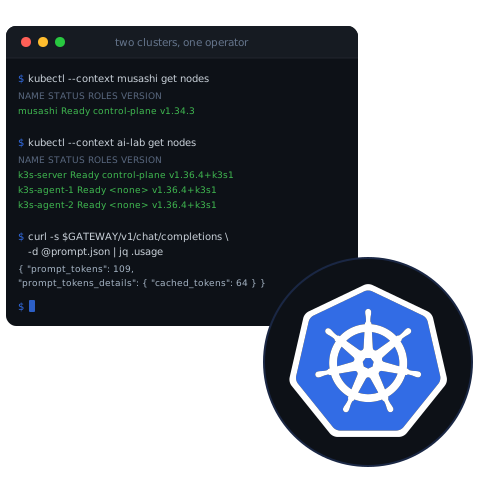
Two terminals — one node in the musashi homelab, three nodes in the k3s AI inference lab — beside the Kubernetes logo

Platform Engineering, Measured

I build infrastructure to find out how it actually behaves — then write down what the measurements said, including when they disagreed with me.

Hi — I’m Igor Furlan, a Site Reliability Engineer working on platform engineering and cloud-native infrastructure.

This site documents two labs I run on my own hardware. They exist for different reasons: one is a long-running production-pattern cluster I operate and keep alive, the other is a short, focused investigation into how distributed LLM serving actually routes traffic.

What they share is the approach. Nothing here is repeated from documentation. Every figure was measured on a running cluster, and the measurements that contradicted what I expected are written up alongside the ones that didn’t — because those are the ones that taught me something.


Kubernetes Homelab

A single bare-metal node — musashi — running a production-pattern cluster: GitOps with ArgoCD, Prometheus-gated canary deployments, full-stack observability, encrypted secrets in git, and a four-layer backup strategy with off-site storage.

Built to practise the patterns a real platform needs, in a place where breaking things costs nothing.

Start with the architecture →

AI Inference Lab

Three virtual machines running llm-d — Gateway API with the Inference Extension, an endpoint picker that routes on KV-cache state, and prefill/decode disaggregation.

Built to answer one question: does cache-aware routing actually beat round-robin? The first answer was no, and finding out why was the interesting part.

Start with the findings →


A benchmark that found nothing

Prefix-aware routing tied with round-robin — 74.7% against 74.2%. That turned out to be exactly 192/259: the shared prompt and nothing else. My test prompts were below the cache’s block size, my memory was too large to ever evict, and the scheduler had one candidate to choose from.

How the experiment was fixed →

A feature that was on and doing nothing

Prefill/decode disaggregation reported enabled for a day while never splitting a single request. Every plugin loaded and every log line was green; the only contradicting evidence was a Prometheus counter that did not exist on one pod.

What was missing →

Canary deployments that roll themselves back

Argo Rollouts promoting or aborting a release based on a live Prometheus query — success rate and latency measured against the canary, not against a stopwatch.

How the pipeline works →


Each badge links to where it is actually used, rather than sitting in a list.


Kubernetes & platform

Kubernetes kubeadm k3s Cilium (eBPF) Traefik Gateway API cert-manager

AI infrastructure

llm-d Inference Extension KV-cache routing Prefill/decode split agentgateway vLLM ollama

GitOps & delivery

ArgoCD Argo Rollouts GitHub Actions Kustomize Helm

Observability

Prometheus Grafana Loki Grafana Alloy AlertManager PodMonitor / ServiceMonitor

Security & secrets

Sealed Secrets Trivy etcd encryption RBAC Let’s Encrypt

Data & resilience

Velero Kopia restic CloudNativePG OCI Object Storage

Infrastructure as code

Vagrant Hyper-V Fedora / RHEL family Rocky Linux